| INDEX | 1300-1599 | 1600s | 1700s | 1800s | 1900s | CROSS-ERA | ETHNO | |
| MISCELLANY | CONTACT | SEARCH | 
|
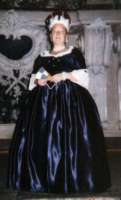
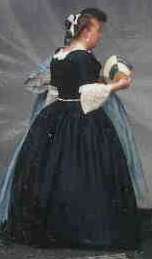
front view, side-back view (better images to follow)
This garment which I have named "robe à l'allemande" for want of an official name is described on a couple of extra pages. I had only four weeks to finish it, including a new panier, because I wanted to wear it to an event in celebration of the 300th birthday of an Elector of Cologne where I was to portray a court lady. The garments I had ready were either too early (the 1680s manteau) or not formal enough (contouche, pet-en-l'air).
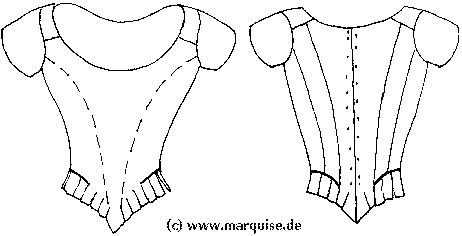
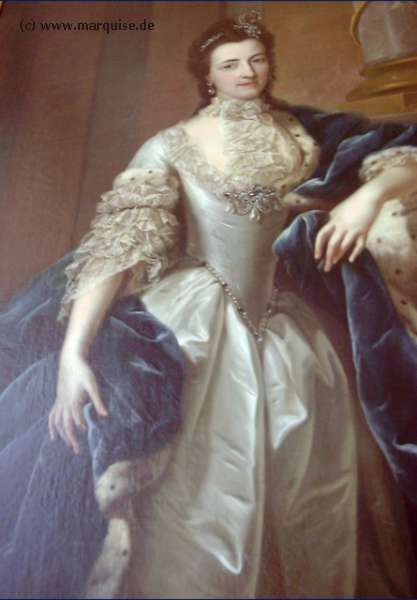
The only sources I could work from were paintings and a pattern taken off an extant garment which was not quite what I wanted. There are no descriptions or patterns in any book I know of. I took the pattern (here's a sketch) and changed it according to my needs. The look I was aiming for was one from the portrait of a countess. Looking closely at other paintings, I had deduced that the bodice was separate from the skirt and worn over it, so in order to achieve the look, I had to remove the front tabs and lengthen the front tip. At hindsight, I should have lengthened it some more. I have also employed longer sleeves to put the lace onto. I left the back tabs there so that they would go under the skirt.
The fabric I chose was a dark blue silk crêpe satin from Hong Kong. I would have preferred something stiffer, but I had this one handy... and it was not enough for any other costume I could think of. Robes take a lot more. There are 280 cm (@ 115) in the skirt and about 110 in the bodice.
The bodice is made of one layer of very strong cotton (the one I use for corsets as well) and one layer of off-white, not quite as strong cotton which serves as a lining. I ironed the generous seam allowances to one side and stitched them down to create a tunnel into which I inserted one bone each. The centre front also got one bone placed between the two layers. Having carefully straightened out the satin on top, i basted it on. I cut out narrow shoulder pieces and attached them so that they would lie as far out on the shoulders as was possible. Then I sewed a strip of the satin onto the outside of the edges with a very narrow allowance, folded it to the inside and thus neatened the edges.
Next were the lacing holes, bored in with an awl (well, an etching needle, in fact - closest thing to an awl that i have). Following recommendations from a mailing list, I went round them with a simple whip stitch, not buttonhole stitch. The sleeves came last. The sleeve head is less curved than usual to allow them to sit low on the shoulder; the lower end is straight.
The panier is based on the pattern for a "large panier" I have online on this site, minus about 5 cm at the top and 20 cm at the bottom. I ran out of tape for the tunnel, so there are only three rows of boning plus the slanted top bones. The resulting shape was too wide and angular at the top, so I shortened the slanted steels and gathered the fabric along the middle of the tunnel until it looked right. Over that went an ugly, whipped-up petticoat meant only to prevent the boning from showing through the soft, flowing silk. Two ribbons attached to the inside pull the panier into an oval but not too flat shape until I get round to putting proper stay pieces in.
For the skirt, I simply took the length of fabric, sewed the ends together, and gathered the top edge to a waistband in knife pleats. The top of the single seam is left open to serve as a pocket slit; another slit (cut) is just opposite half around the skirt. The pleats face away from the centre front and back, respectively, and get deeper and more slanted as they get closer to the sides as the panier needs more width around the sides. The waistband is made of a strip of the top fabric as the skirt sits on top of the bodice in back, so it should not be too obvious. It is open at the side, where the seam-cum-pocket slit is, and ties with a bow. Then I put the skirt on over the panier and had my mother mark the hem.
Now that the dress was in a wearable state, I could use the rest of the little time I had left for the decoration. I had bought quite a lot of off-white pearls (artificial, of course) and some smaller ones in off-white and dark blue. I threaded them onto a dark blue string: Eight big ones, then six small white ones, back through the first small one to create a circle, then a blue one and through the third of the white ones again so that the blue pearl sat in the middle of the circle. And eight big ones again... Then I sewed the string to the lower edge of the bodice. From the side seams on, it follows a straight line to the centre back edge, otherwise it would later be covered up by the skirt.
I only just had time left to sew four teardrop-shaped off-white pearls to the front - I plan to "connect" them with couched silver thread embroidery to emulate stomacher jewelry - and a strip of bobbin lace to the sleeve hems.
What is left to do now, after having worn it once, is to put a stronger and longer bone in the centre front to get rid of the annoying horizontal folds, to put more layers of lace or chiffon onto the sleeves to reach almost all the way to the shoulder, edge the neckline with lace, and to shorten the skirt hem a bit. If I find it within me, I might also sew pearls onto the hem. That should put an end to the undignified billowing-up in windy weather. I may also need a new chemise with a neckline different from that used for the contouche and a corset with shoulder straps further out on the shoulders - or even strapless.
When all's said and done, I'm quite content with the outcome. Yet.
Update, a year later: I've looked at even more paintings and arrived at the conclusion that I could either have the French court style with very short sleeves and then lace all down to the elbow (I don't have that much lace, at least not of the same design) or the more casual-looking one with longer, flabby sleeves and quite a bit of chemise sleeve sticking out. I chose the latter, mainly for economical reasons. So the allemande now has got new sleeves which widen towards the elbows and are lined with white silk satin. The lower bit is turned up at the crook of the elbow, turning the white lining outside, and held in place by a star made out of pearls threaded onto thin wire.
Content, layout and images of this page
and any sub-page of the domains marquise.de, contouche.de,
lumieres.de, manteau.de and costumebase.org are copyright (c) 1997-2022 by Alexa Bender. All rights
reserved. See Copyright Page.

GDPO


This work is licensed under a Creative Commons License.